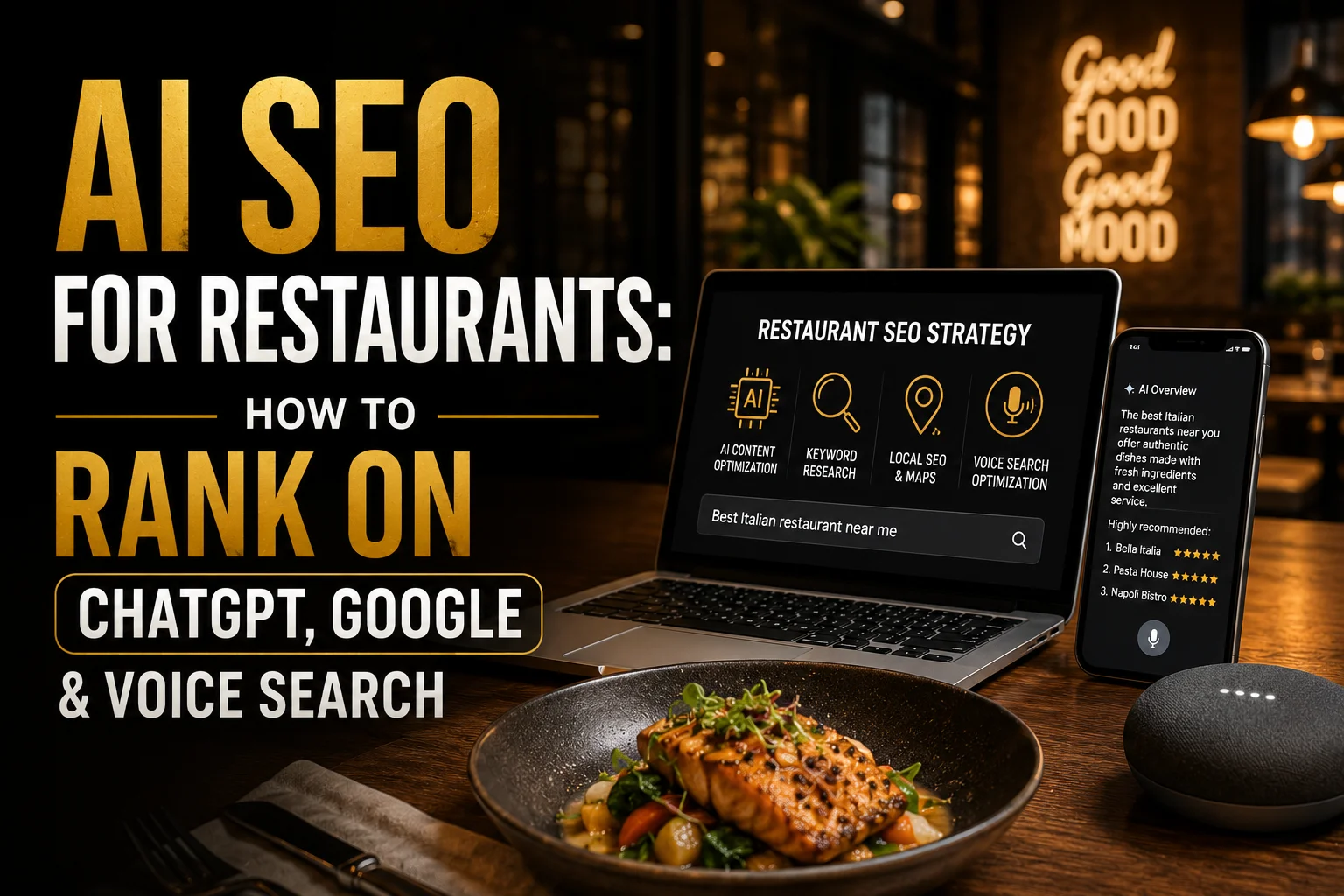
Running a great restaurant is only half the challenge. The other half is making sure hungry customers can find you when they search online.
Imagine someone in Houston searching for “halal restaurant near me,” a family in Chicago looking for “best pizza delivery,” or a couple in Los Angeles searching for “Italian restaurant with outdoor seating.” These customers already know what they want. The question is whether your restaurant appears when they search.
That is where restaurant search engine optimization (SEO) becomes essential.
An effective restaurant SEO strategy helps search engines understand your location, cuisine, menu, and services while making it easier for customers to discover your business.
Whether you operate a small neighborhood café, a family-owned restaurant, or a multi-location food business, this 25-step restaurant SEO checklist will help you improve your online presence, strengthen your Google Maps visibility, and attract more local customers.
What Is Restaurant SEO?
Restaurant SEO is the process of improving a restaurant’s visibility in organic search results and local search platforms, particularly Google Search and Google Maps.
It involves optimizing your website, Google Business Profile, menu pages, business listings, customer reviews, and locally relevant content.
For example, a Mexican restaurant in Dallas might want to appear for searches such as:
- Mexican restaurant in Dallas
- Tacos near me
- Best Mexican food in Dallas
- Mexican restaurant open late
- Mexican food delivery near downtown Dallas
A successful SEO strategy helps connect the restaurant with people making these searches.
Google explains that local rankings are primarily influenced by relevance, distance, and prominence. While restaurant owners cannot control how far a customer is from their location, they can improve business information, website relevance, and online reputation.
The Complete 25-Step Restaurant SEO Checklist
Use the following checklist to identify opportunities, fix common problems, and build a stronger foundation for long-term local search visibility.
Part 1: Google Business Profile Optimization
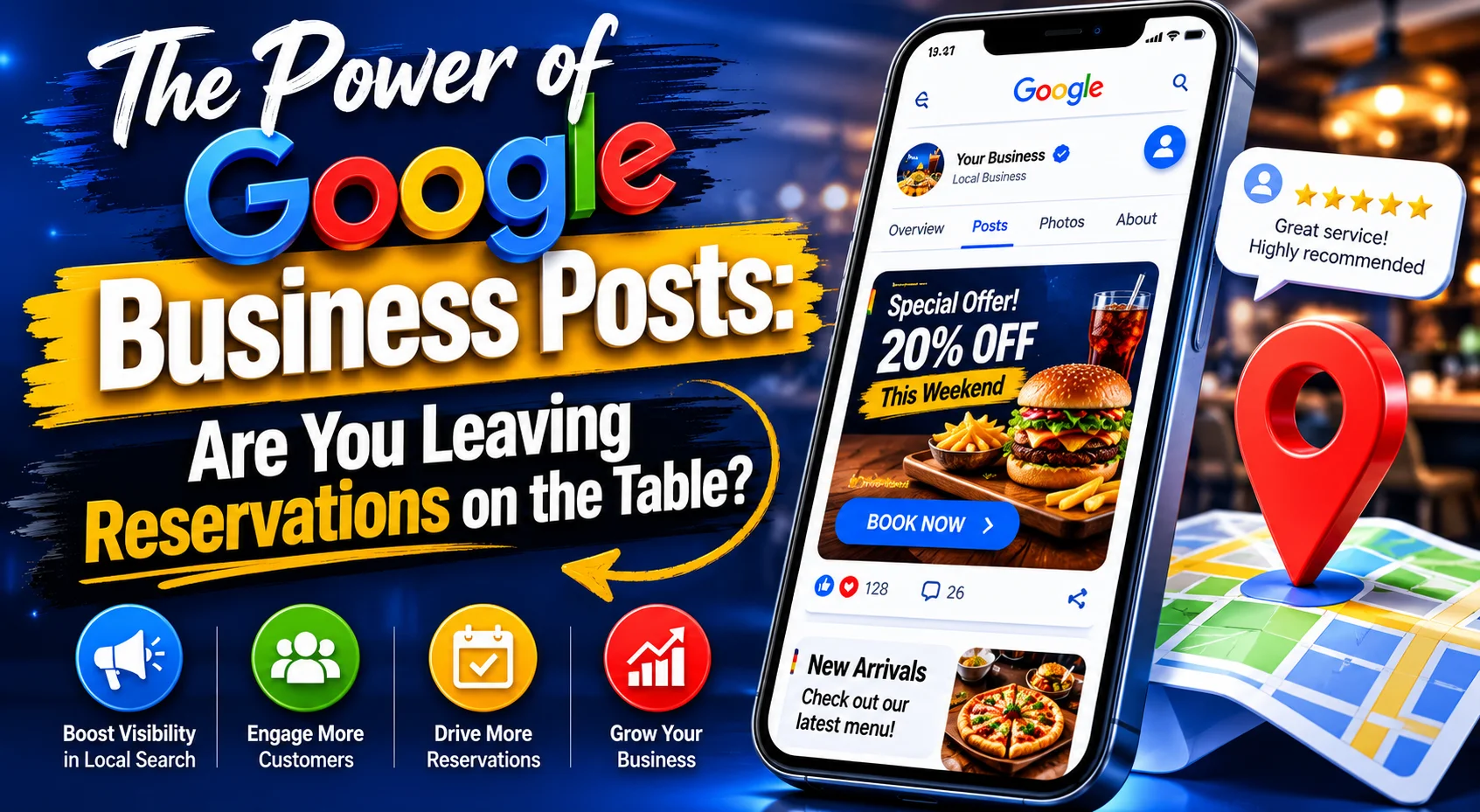
For restaurants, Google Business Profile is one of the most important digital assets because it connects your business with customers using Google Search and Maps.
1. Claim and Verify Your Google Business Profile
Start by claiming and verifying your restaurant’s Google Business Profile.
An unclaimed or incomplete profile can make it harder to control important business information.
After verification, check that your profile contains:
- Your actual restaurant name
- Correct physical address
- Local phone number
- Website URL
- Accurate business hours
- Appropriate restaurant category
For example, if you own an Indian restaurant in Sugar Land, Texas, your profile should accurately represent that location rather than using an address in a neighboring city.
SEO action: Search your restaurant’s name on Google Maps and confirm that you have access to manage the correct listing.
2. Select the Most Accurate Business Categories
Your primary Google Business Profile category should describe your restaurant as specifically as possible.
Depending on your business, suitable categories may include:
- Indian Restaurant
- Mexican Restaurant
- Pizza Restaurant
- Chinese Restaurant
- Pakistani Restaurant
- Fast Food Restaurant
- Coffee Shop
Choose additional categories only when they genuinely describe your business.
For example, a restaurant that serves Indian cuisine should not select unrelated categories simply to appear in more searches.
SEO action: Review the primary categories used by relevant local competitors and choose the most accurate category for your restaurant.
3. Write an Informative Restaurant Business Description
Your Google Business Profile description should explain what makes your restaurant useful and distinctive.
Mention your cuisine, dining experience, signature dishes, and location naturally.
Example:
“Enjoy freshly prepared Indian and Pakistani cuisine in Sugar Land, TX. Our restaurant serves flavorful biryani, traditional curries, grilled specialties, and family-friendly meals for dine-in, takeout, and delivery.”
Avoid repeating phrases such as “best restaurant near me” or inserting unnecessary keywords.
A useful description helps customers understand your restaurant before they visit.
4. Keep Restaurant Hours and Contact Information Accurate
Incorrect business hours can frustrate customers and cause missed visits.
Review your profile whenever your operating schedule changes.
Pay particular attention to:
- Weekend hours
- Holiday schedules
- Temporary closures
- Seasonal operating hours
- Special events
Make sure the hours displayed on Google match those published on your website and other major listings.
SEO action: Review business hours monthly and update special hours before major holidays.
5. Upload Authentic Restaurant Photos
Customers often want to see your food, dining space, and atmosphere before deciding where to eat.
Upload clear, genuine photos showing:
- Popular menu items
- Restaurant exterior
- Dining area
- Staff and food preparation
- Special dishes
- Seating arrangements
For example, a burger restaurant might showcase its signature cheeseburger, fries, restaurant interior, and storefront.
Use accurate, current photos rather than misleading stock images.
SEO action: Refresh your photo collection when your menu, restaurant interior, or seasonal offerings change.
6. Optimize Your Menu and Ordering Information on Google
Your Google Business Profile should make it easy for customers to view your menu and access ordering options.
Where supported, add your menu details and appropriate ordering links.
Check that menu information matches your website, including:
- Dish names
- Prices
- Menu categories
- Availability
- Dietary information
- Ordering options
A customer searching for chicken biryani should be able to understand whether your restaurant serves it without navigating through confusing information.
For a more detailed approach to restaurant visibility on Google Maps, explore our Google Business Profile optimization services.
Part 2: Restaurant Website SEO
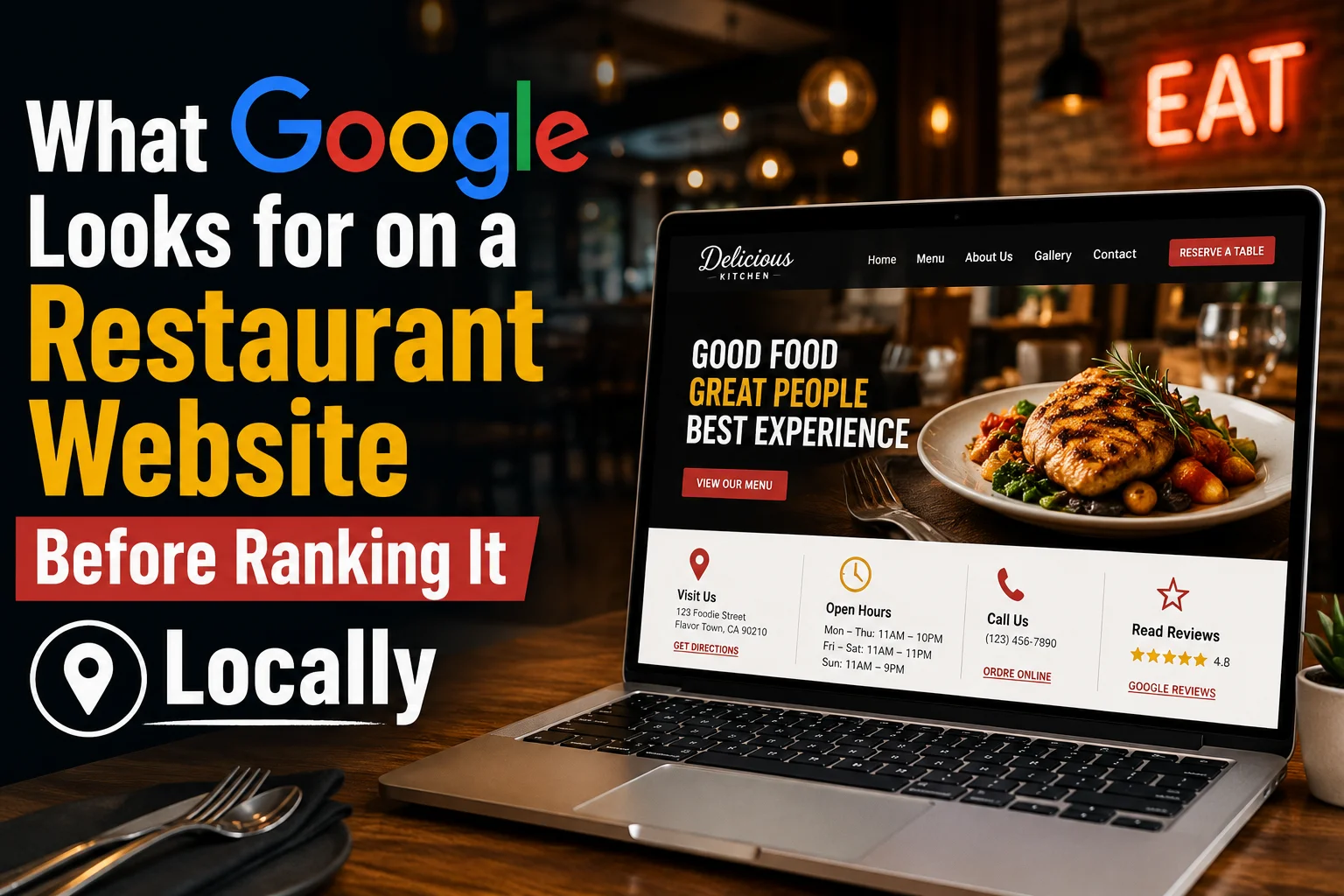
Your website should help search engines understand your restaurant while guiding visitors toward ordering, booking, calling, or visiting.
7. Make Your Restaurant Website Mobile-Friendly
Many restaurant customers search while using their smartphones.
A mobile-friendly restaurant website should allow visitors to find essential information without unnecessary scrolling or zooming.
Prioritize:
- Readable text
- Simple navigation
- Clickable phone numbers
- Easy-to-use menu pages
- Visible ordering buttons
- Accessible reservation options
Imagine a customer searching for lunch during a short work break. If your website is difficult to navigate, they may choose another restaurant.
SEO action: Test your homepage, menu, and ordering process on different mobile screen sizes.
8. Improve Website Loading Speed
A slow website can interrupt the customer journey, especially when visitors are trying to browse menus or place orders.
Common causes of slow restaurant websites include oversized images, unnecessary scripts, excessive plugins, and poorly optimized themes.
To improve performance:
- Compress food images without sacrificing quality.
- Use modern image formats where appropriate.
- Enable suitable caching.
- Reduce unnecessary JavaScript.
- Optimize fonts and third-party widgets.
- Use reliable hosting.
Monitor Core Web Vitals, including Largest Contentful Paint, Interaction to Next Paint, and Cumulative Layout Shift.
SEO action: Test important pages using Google PageSpeed Insights and prioritize issues affecting real mobile visitors.
9. Optimize Restaurant Page Titles and Meta Descriptions
Every important restaurant page should have a unique, descriptive SEO title.
A useful title combines the restaurant’s service or cuisine with its location.
Example homepage title:
Indian Restaurant in Sugar Land, TX | Example Restaurant
Example meta description:
Explore freshly prepared Indian cuisine in Sugar Land, TX. Browse our menu, discover signature dishes, and order online for pickup or delivery.
Avoid copying the same title across multiple pages.
Meta descriptions are not a direct ranking factor, but well-written descriptions can help communicate page relevance and encourage clicks when Google displays them.
10. Create a Search-Friendly HTML Menu
Your menu is one of the most valuable sections of your restaurant website.
Instead of relying entirely on a downloadable PDF, create an accessible HTML menu with organized categories.
For example:
Main Menu
- Appetizers
- Chicken Specialties
- Beef and Lamb Dishes
- Vegetarian Options
- Rice and Biryani
- Desserts
- Beverages
Include useful descriptions of individual dishes where appropriate.
A pizza restaurant might describe a menu item as:
“Chicken Tikka Pizza — freshly baked pizza topped with seasoned chicken tikka, mozzarella cheese, onions, and our signature sauce.”
This provides meaningful information to customers and search engines.
Google can index PDF files, but HTML menus generally offer greater flexibility for mobile navigation, internal linking, and content updates.
Read our detailed guide on restaurant menu SEO: PDF vs HTML to understand how menu formatting affects usability and search visibility.
11. Add Restaurant Structured Data
Structured data helps search engines interpret information about your business.
Restaurants can use the Restaurant subtype of LocalBusiness schema to describe relevant details, including:
- Restaurant name
- Address
- Telephone number
- Opening hours
- Cuisine type
- Menu URL
- Website URL
For restaurants with multiple locations, each location should have accurate, location-specific information.
Structured data does not guarantee higher rankings or special search features, but it can help Google understand your business details.
SEO action: Add accurate Restaurant schema and validate it using Google’s Rich Results Test.
Part 3: Local Keyword Research and On-Page SEO
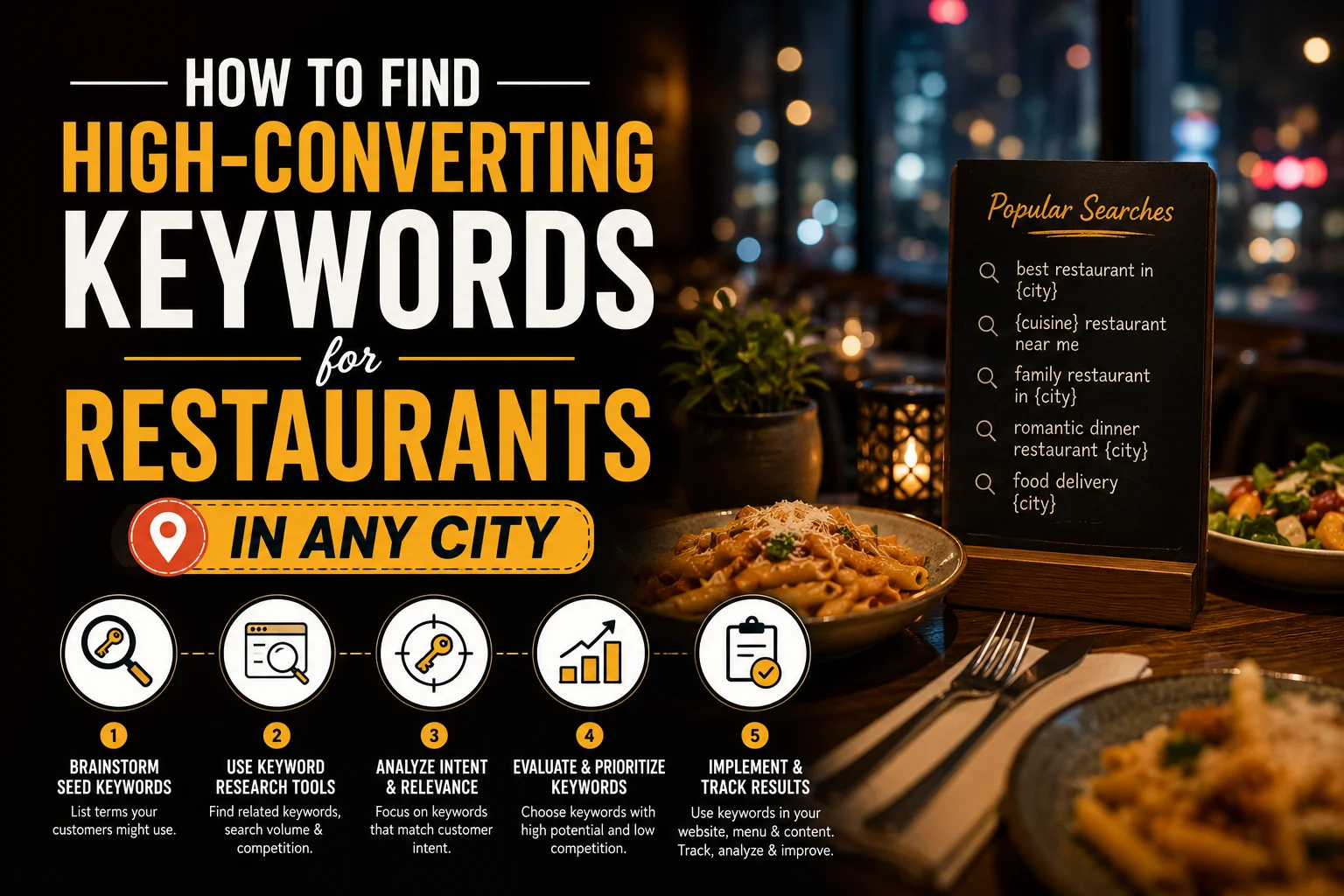
Finding the right keywords helps your restaurant reach customers who are looking for the food and services you actually offer.
12. Research High-Intent Local Restaurant Keywords
Not every restaurant keyword has the same business value.
A broad search such as “pizza” may have many possible meanings, while “pizza delivery in Houston” shows a clearer local intent.
Useful keyword categories include:
| Keyword type | Example |
|---|---|
| Cuisine + City | Indian restaurant in Houston |
| Dish + Location | Chicken biryani in Sugar Land |
| Service + City | Pizza delivery in Dallas |
| Restaurant + Neighborhood | Mexican restaurant in Midtown |
| Dietary Preference | Halal burgers in Houston |
| Occasion-Based | Family dinner restaurant in Austin |
Use tools such as Google Search Console, Ahrefs, Semrush, and Google Keyword Planner to research relevant terms.
SEO action: Group keywords according to search intent rather than creating a separate page for every keyword variation.
13. Optimize Homepage Headings and Content
Your homepage should clearly explain what your restaurant offers and where it operates.
A practical heading structure might look like this:
H1: Authentic Pakistani Restaurant in Houston, TX
H2: Explore Our Traditional Pakistani Menu
H2: Dine In, Order Pickup, or Get Delivery
H2: Visit Our Houston Restaurant
H2: Frequently Asked Questions
Include relevant cuisine and location terms naturally.
Avoid repeating the same city name in every heading or paragraph.
Google recommends creating helpful, people-first content rather than pages written primarily to manipulate search rankings.
14. Create Unique Pages for Genuine Restaurant Locations
If your restaurant operates in multiple physical locations, each branch can benefit from its own landing page.
For example:
/locations/houston//locations/sugar-land//locations/katy/
Each page should contain genuinely useful location-specific information.
Include the branch address, hours, phone number, directions, available services, and relevant menu details.
Do not create near-identical pages for every surrounding city simply to capture additional keywords.
SEO action: Build individual location pages only where there is a legitimate business or user need.
15. Optimize Images With Descriptive Alt Text
Restaurant websites depend heavily on food photography.
However, search engines and visitors using assistive technologies also benefit from meaningful image descriptions.
Example image filename:
chicken-biryani-houston-restaurant.webp
Example alt text:
“Chicken biryani served with raita at a Houston Pakistani restaurant”
Use alt text to describe the actual image rather than inserting unrelated keywords.
Decorative images generally do not need descriptive alt text.
Part 4: Local Authority and Reputation Management
Your restaurant’s online reputation influences how customers evaluate your business.
16. Maintain Consistent Restaurant Business Listings
Your restaurant’s core business information should remain accurate across important online platforms.
Check your listings on relevant services such as:
- Google Business Profile
- Apple Maps
- Bing Places
- Yelp
- TripAdvisor
- Relevant local business directories
Ensure the restaurant name, address, phone number, and website are correct.
For example, if your restaurant moves to a new location, update old directory listings instead of leaving conflicting addresses online.
SEO action: Audit major listings and correct inaccurate or duplicate information.
17. Build a Consistent Google Review Strategy
Customer reviews can help potential diners evaluate your food, service, and atmosphere.
Google also identifies review quantity and positive ratings as factors that can contribute to local prominence.
Encourage genuine customers to share their experiences.
Practical methods include placing a review QR code near the checkout counter or including a review request on receipts.
Never purchase reviews, offer incentives in exchange for reviews, or selectively request reviews only from satisfied customers.
SEO action: Create a simple, policy-compliant process for requesting honest customer feedback.
18. Respond Professionally to Customer Reviews
Review management should be part of your restaurant’s regular operations.
Thank customers for positive feedback and address negative experiences respectfully.
Example positive review response:
“Thank you for dining with us! We’re glad you enjoyed your meal and appreciate you taking the time to share your experience.”
Example negative review response:
“We’re sorry your visit did not meet expectations. We appreciate your feedback and would welcome the opportunity to discuss your experience directly.”
Avoid sharing private customer details or arguing publicly.
Restaurants looking to improve their review process can explore our restaurant reputation management services.
19. Earn Relevant Local Backlinks
Backlinks are links from other websites to your restaurant website.
Relevant links can help search engines discover your business and contribute to your website’s authority.
Consider earning links through:
- Local food publications
- Community organizations
- Genuine restaurant partnerships
- Local event sponsorships
- Neighborhood business associations
- Food bloggers reviewing your restaurant
For example, participating in a legitimate Houston food festival may create opportunities for your restaurant to be featured on an event website.
Focus on editorially earned, relevant links instead of buying large quantities of low-quality backlinks.
20. Build Your Restaurant’s Local Community Presence
Local SEO extends beyond website optimization.
Participating in community activities can help your restaurant become more recognizable.
Consider collaborating with nearby businesses, supporting local events, or participating in community food initiatives.
These activities may generate brand mentions, referral traffic, customer awareness, and opportunities for relevant local coverage.
Not every social mention or community activity directly improves rankings, but genuine local visibility can support your broader marketing strategy.
Part 5: Content, Conversion, and Performance Tracking
A successful restaurant SEO strategy should help customers take action, not simply increase website traffic.
21. Publish Helpful Restaurant Content
Your restaurant blog can answer questions that potential customers are already asking.
For example, an Indian restaurant might publish articles about:
- Popular Indian dishes for first-time visitors
- Vegetarian Indian meal options
- Biryani varieties and ingredients
- Catering options for family celebrations
- Choosing dishes for a group dinner
A seafood restaurant might explain seasonal seafood specials or how different dishes are prepared.
Avoid publishing generic articles that have no connection to your actual restaurant.
SEO action: Create content that demonstrates your menu knowledge, services, and genuine customer experience.
22. Optimize for Conversational and Voice Searches
Customers increasingly use conversational questions when searching for restaurants.
Examples include:
- Where can I find halal food near me?
- Which Italian restaurants are open late in Dallas?
- Does this restaurant offer vegetarian options?
- Where can I order family-size pizza in Houston?
Answer relevant questions naturally on your website.
For example, a restaurant FAQ might include:
Do you offer vegetarian options?
“Yes, our menu includes several vegetarian dishes, including vegetable biryani, lentil curry, and seasonal vegetable specialties.”
Only describe services and menu options your restaurant actually provides.
Clear answers can improve usability and help search systems understand your content, although there is no guaranteed voice-search ranking technique.
23. Make Online Ordering and Reservations Easy
Restaurant SEO should support real business outcomes.
Once visitors reach your website, they should quickly understand how to order food, book a table, or contact your team.
Use clear calls to action such as:
- Order Online
- View Our Menu
- Reserve a Table
- Call for Pickup
- Get Directions
Keep important actions visible on mobile devices.
If your restaurant uses a third-party ordering platform, test the entire ordering journey to ensure it works correctly.
SEO action: Check that customers can complete an order or reservation without unnecessary steps.
24. Track Restaurant SEO Performance
Without reliable performance data, it is difficult to determine whether your SEO improvements are working.
Use Google Search Console to monitor:
- Organic clicks
- Search impressions
- Search queries
- Average search position
- Important landing pages
Use Google Analytics 4 to measure meaningful website interactions and conversions where configured.
Google Business Profile performance data can also help you understand customer actions associated with your listing.
Track business outcomes such as online orders, completed reservation requests, calls, and direction requests where reliable measurement is available.
SEO action: Compare performance over meaningful periods and account for seasonal changes.
25. Perform a Monthly Restaurant SEO Audit
Restaurant SEO requires ongoing maintenance.
Menus change, competitors update their websites, customer reviews accumulate, and search behavior evolves.
Create a monthly review process covering:
- Google Business Profile accuracy
- Website indexing issues
- Broken internal links
- Menu updates
- Local keyword visibility
- Customer reviews
- Mobile website performance
- Organic traffic and conversions
Prioritize issues that directly affect customers or prevent search engines from accessing important pages.
A consistent monthly audit helps your restaurant identify problems before they become larger obstacles.
Restaurant SEO Checklist: Quick Reference
Use this summary to organize your restaurant’s SEO work.
| SEO Task | Recommended Frequency |
|---|---|
| Verify Google Business Profile details | Monthly and whenever information changes |
| Review business categories | When business offerings change |
| Update business descriptions | As needed |
| Check business hours | Monthly and before holidays |
| Upload authentic photos | As new photos become available |
| Review menu and ordering information | Whenever the menu changes |
| Test mobile usability | Monthly and after major website updates |
| Monitor website speed | Monthly |
| Review page titles and descriptions | During content audits |
| Maintain HTML menu | Whenever items or prices change |
| Validate structured data | After relevant website changes |
| Research local keywords | Quarterly |
| Improve homepage content | As needed |
| Update location pages | Whenever location details change |
| Review image alt text | When adding or updating images |
| Audit business listings | Quarterly |
| Request genuine reviews | Ongoing |
| Respond to customer reviews | Regularly |
| Earn relevant local backlinks | Ongoing |
| Participate in local community activities | As opportunities arise |
| Publish helpful restaurant content | According to an achievable schedule |
| Update conversational FAQs | As customer questions change |
| Test ordering and reservations | Monthly |
| Review SEO performance | Monthly |
| Conduct a complete SEO audit | Monthly or quarterly |
Common Restaurant SEO Mistakes to Avoid
Even restaurants with attractive websites can struggle with local visibility when important details are overlooked.
Keyword Stuffing
Repeating phrases such as “best pizza restaurant in Houston” throughout every paragraph does not create a better customer experience.
Use relevant keywords naturally and focus on providing useful information.
Creating Duplicate Location Pages
Publishing nearly identical pages for dozens of nearby cities can create low-value content.
Each location page should serve a genuine purpose and provide distinctive information.
Ignoring Negative Reviews
Unanswered complaints can discourage potential customers.
Respond respectfully, investigate legitimate concerns, and use feedback to improve operations.
Using Outdated Menus
Incorrect prices, unavailable dishes, and broken ordering links create frustration.
Keep your website menu and business listings synchronized.
Focusing Only on Rankings
Higher rankings are useful, but they do not automatically produce more revenue.
Measure calls, reservations, orders, and other meaningful customer actions alongside organic visibility.
How Long Does Restaurant SEO Take to Show Results?
Restaurant SEO is a gradual process, and there is no universal timeline for reaching specific rankings.
Some improvements, such as correcting business hours or fixing broken menu links, can improve the customer experience quickly.
Other improvements, including building local authority and increasing organic search visibility, may take several months to produce measurable results.
The timeline depends on factors such as:
- Competition in your city
- Existing website quality
- Google Business Profile completeness
- Restaurant reputation
- Website history and authority
- Quality of ongoing SEO work
For example, a newly opened restaurant in a competitive downtown market may require a different strategy from an established neighborhood café.
Instead of expecting guaranteed rankings, establish a performance baseline and monitor improvements consistently.
Frequently Asked Questions About Restaurant SEO
1. What is the most important SEO factor for restaurants?
There is no single factor that determines every restaurant’s rankings. For Google Maps, relevance, distance, and prominence are particularly important. A complete Google Business Profile, accurate website information, and a strong reputation are valuable starting points.
2. How can I improve my restaurant’s Google Maps ranking?
Verify and complete your Google Business Profile, choose accurate categories, maintain correct business information, encourage genuine reviews, and build a relevant online presence. Rankings also depend on the searcher’s location and competition.
3. Do restaurants really need SEO?
SEO can help restaurants become more visible when nearby customers search for relevant cuisines, dishes, dining options, or delivery services. It is especially useful for restaurants that depend on local discovery.
4. How much does restaurant SEO cost?
Costs vary according to the restaurant’s location, competition, number of branches, website condition, and required services. A small single-location restaurant may need a different level of support from a multi-location restaurant group.
5. Can restaurant SEO increase online orders?
SEO can help attract customers searching for relevant food and ordering options. However, actual order growth also depends on menu appeal, pricing, website usability, delivery availability, and the ordering experience.
6. Should every restaurant have a website?
A dedicated website gives restaurants greater control over their menus, branding, ordering links, location information, and customer experience. It also provides opportunities to attract organic search traffic beyond third-party platforms.
7. How often should restaurants update their SEO?
Business details should be updated whenever they change. Performance should be reviewed regularly, while technical audits, content improvements, and competitor research can be scheduled monthly or quarterly.
8. Is Google Business Profile enough for restaurant SEO?
Google Business Profile is important for local visibility, but a restaurant website provides additional opportunities to rank for menu items, cuisine searches, location-specific queries, and customer questions.
Final Thoughts: Turn Local Searches Into Restaurant Customers
Improving restaurant visibility requires more than adding keywords to a website.
A successful restaurant SEO strategy connects accurate business information, helpful website content, strong local relevance, genuine customer reviews, and an easy ordering experience.
The 25 steps in this restaurant SEO checklist provide a practical framework for improving your digital presence.
Start with the essentials: verify your Google Business Profile, optimize your restaurant website, improve your menu, and make it easy for customers to contact or visit you.
Then build on that foundation with local content, reputation management, relevant backlinks, and consistent performance tracking.
Need help improving your restaurant’s local SEO?
At Local SEO for Restaurants, we help restaurant owners improve their online visibility through restaurant-focused SEO strategies, Google Business Profile optimization, and website improvements.
Explore our restaurant SEO services or request a free SEO audit to identify opportunities for your restaurant.