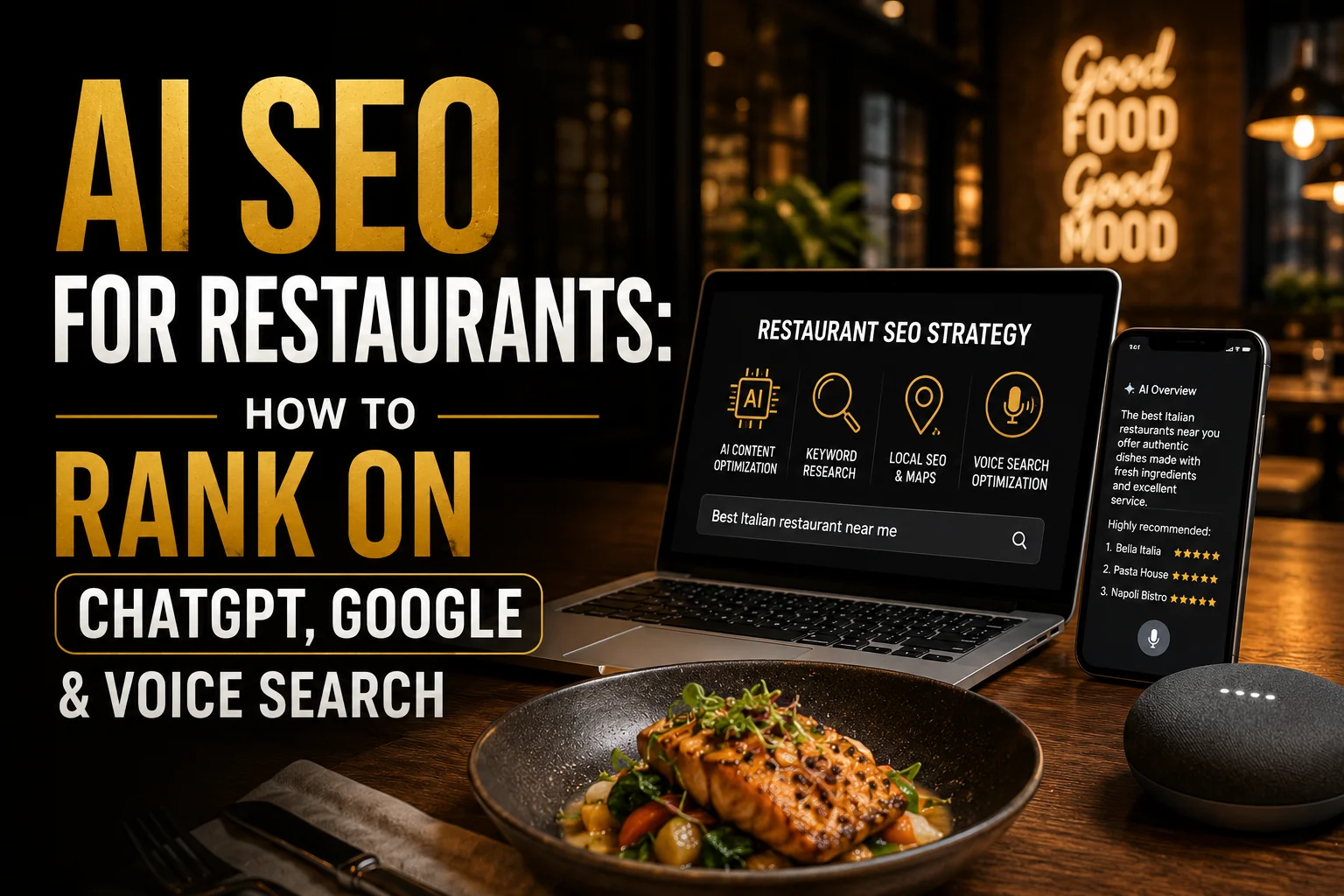
What if your restaurant could appear exactly when hungry customers ask ChatGPT, Google, or Siri where to eat next? In today’s digital world, that’s no longer just a marketing advantage — it’s the future of restaurant visibility.
People are searching differently than they did a few years ago. Instead of typing simple keywords into Google, they now ask questions like:
- “What’s the best Italian restaurant near me?”
- “Where can I get late-night tacos in Dallas?”
- “Best family-friendly restaurant in Chicago?”
Search engines and AI tools are becoming smarter, more conversational, and heavily focused on user intent. That’s why AI SEO for restaurants has become one of the most powerful ways to attract local customers, increase reservations, and grow online visibility in the United States.
If your restaurant is not optimized for AI-driven search, you may already be losing customers to competitors who are.
What Is AI SEO for Restaurants?
AI SEO is the process of optimizing your restaurant’s online presence so platforms like ChatGPT, Google, Siri, Alexa, and voice search assistants can easily understand and recommend your business.
Traditional SEO focused mainly on rankings. AI SEO focuses on:
- User intent
- Conversational searches
- Voice search optimization
- Local SEO
- AI-generated answers
- Helpful, human-centered content
In simple terms, AI SEO helps your restaurant become the answer customers see first.
Why AI Search Is Changing the Restaurant Industry
The way people discover restaurants has changed dramatically. Customers now rely on:
- Google Maps
- ChatGPT recommendations
- Voice assistants
- Mobile searches
- AI-powered search summaries
Most users make dining decisions within minutes. If your restaurant appears at the top during that decision-making moment, you gain a huge competitive edge.
Here’s Why AI SEO Matters:
- Increases local visibility
- Drives more reservations
- Improves Google Maps rankings
- Helps customers discover your menu faster
- Boosts online orders
- Builds long-term brand trust
Restaurants that adapt early to AI-powered search are positioning themselves for long-term growth.
Optimize Your Google Business Profile
Your Google Business Profile is one of the most important assets for local restaurant SEO.
When someone searches for restaurants nearby, Google uses your profile information to decide whether your business deserves visibility.
Make Sure Your Profile Includes:
- Accurate restaurant name
- Updated address and phone number
- Business hours
- Website URL
- Reservation links
- High-quality food photography
- Updated menus
- Customer reviews
A fully optimized profile increases your chances of appearing in:
- Google Maps
- “Near me” searches
- Voice search results
- AI-generated recommendations
Pro Tip
Use natural local keywords in your description, such as:
- Best seafood restaurant in Miami
- Family dining in Houston
- Rooftop restaurant in New York
This helps search engines understand exactly what your restaurant offers.
Focus on Conversational Keywords
Modern customers don’t search like robots anymore. They search naturally.
Instead of typing:
- “Best burgers NYC”
They ask:
- “Where can I find the best burgers near Times Square?”
- “What restaurant serves the best steak in Dallas?”
- “Best brunch place open right now”
This is why conversational keywords matter.
Smart AI SEO Keyword Examples
- Best pizza place near downtown Chicago
- Romantic restaurants in Los Angeles
- Affordable sushi restaurant in Seattle
These long-tail keywords match how real users speak and search online.
Create Content That Feels Human
Google’s Helpful Content Update rewards websites that genuinely help users instead of simply trying to manipulate rankings.
Your restaurant content should:
- Answer customer questions
- Offer useful recommendations
- Share authentic insights
- Sound natural and engaging
Blog Ideas That Work Well
- Best Outdoor Dining Spots in Austin
- Top Vegan Restaurants in California
- Where to Find Authentic BBQ in Texas
- Best Family Restaurants in Orlando
Helpful content builds trust and positions your restaurant as a reliable local choice.
Voice Search Is the Future
Voice search continues to grow rapidly across the United States. People now ask Siri, Alexa, and Google Assistant for instant dining recommendations while driving, shopping, or relaxing at home.
That means your content should sound conversational.
Tips to Optimize for Voice Search
- Use question-style headings
- Keep answers short and direct
- Add FAQ sections
- Include local keywords naturally
- Write in a conversational tone
For example, instead of saying:
“Our restaurant provides quality seafood dishes.”
Say:
“Looking for fresh seafood in Boston? Our restaurant serves locally sourced seafood favorites perfect for lunch, dinner, and weekend gatherings.”
This sounds more natural and aligns better with voice search behavior.
Mobile Optimization Is Non-Negotiable
Most restaurant searches happen on smartphones. If your website loads slowly or feels difficult to use, potential customers will leave within seconds.
Your website should:
- Load quickly
- Be mobile-friendly
- Show menus clearly
- Offer click-to-call functionality
- Include online reservations
- Display directions easily
A smooth mobile experience improves both rankings and customer conversions.
Reviews Build Trust and Rankings
Online reviews influence both search visibility and customer decisions.
Positive reviews signal credibility to Google and AI platforms.
Encourage customers to leave reviews on:
- Yelp
- TripAdvisor
Also, respond professionally to every review. Active engagement shows trustworthiness and improves your online reputation.
Conclusion
AI SEO for restaurants is no longer optional — it’s becoming the foundation of modern restaurant marketing. Customers are using ChatGPT, Google, and voice assistants every day to decide where to eat, and restaurants that optimize for these platforms will gain a major advantage.
By focusing on conversational keywords, voice search optimization, local SEO, mobile experience, and helpful content, your restaurant can attract more customers and stay ahead of the competition.
The future of restaurant marketing belongs to businesses that adapt early and create experiences both search engines and customers trust.
FAQs
What is AI SEO for restaurants?
AI SEO helps restaurants rank better on ChatGPT, Google, voice search, and AI-powered search tools.
Why is voice search important for restaurants?
Many customers now use voice assistants to quickly find nearby restaurants and dining options.
Can small restaurants benefit from AI SEO?
Yes, even small local restaurants can increase visibility and attract more customers through AI SEO.
Does Google Business Profile improve local rankings?
Absolutely. It’s one of the strongest ranking factors for local restaurant SEO.
How long does restaurant SEO take to show results?
Most restaurants start seeing noticeable improvements within a few months.
Ready to Grow Your Restaurant Online?
If you want your restaurant to appear where modern customers are searching — on ChatGPT, Google, and voice assistants — now is the perfect time to invest in smart AI SEO strategies. Contact Local SEO For Restaurants and start growing your restaurant’s online visibility today.