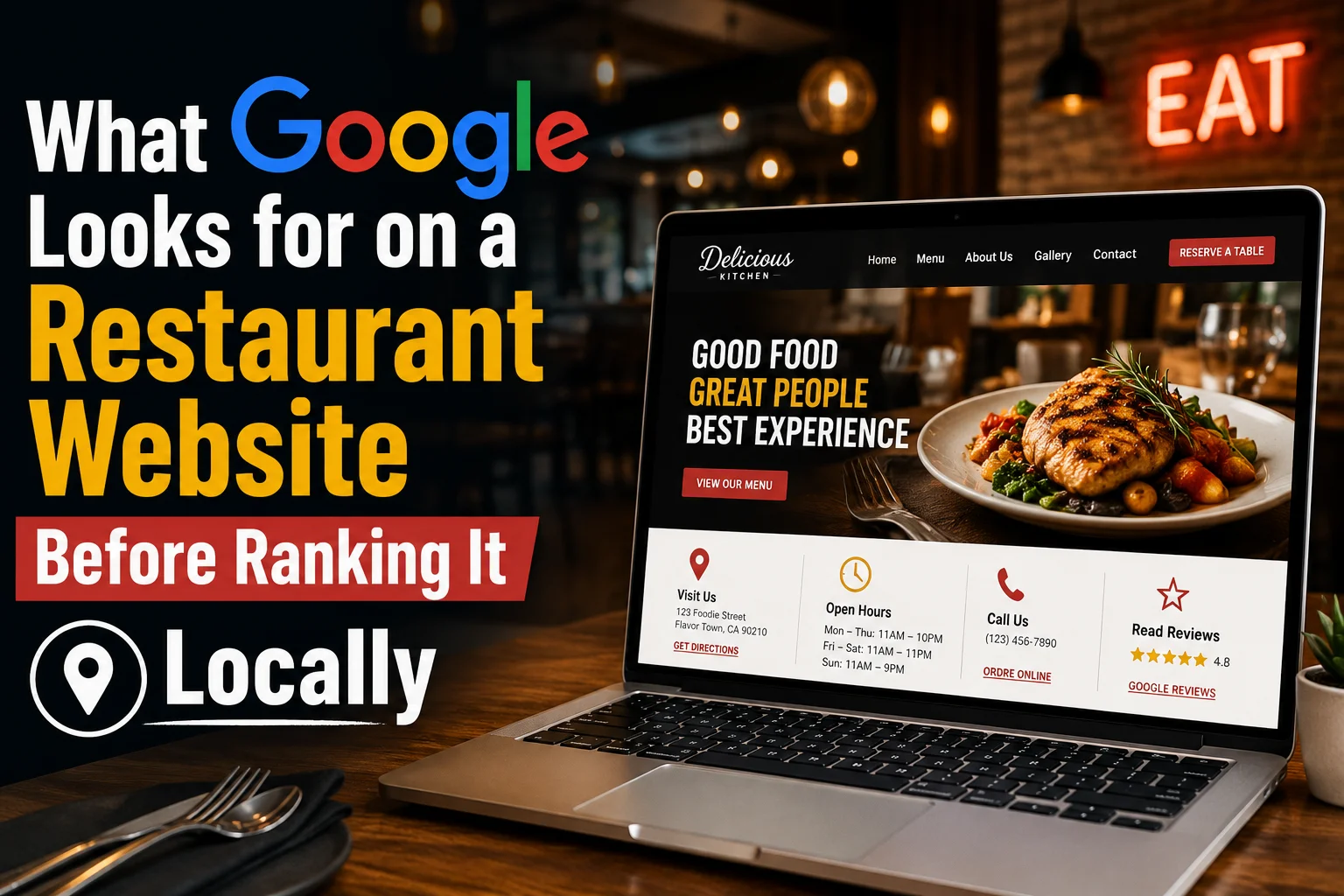
Ever wonder why your restaurant doesn’t appear in local Google searches while your competitors dominate the top spots? The answer isn’t just having a website ,it’s about building a site and online presence that signals trust, relevance and authority to Google. If you want your restaurant to show up for searches like “best sushi near me” or “family-friendly Italian restaurant in Boston,” you need to understand what Google looks for before ranking a restaurant locally.
In this guide, we break down the key factors Google evaluates so you can optimize your restaurant website, increase online visibility and attract more diners.
1. Complete and Accurate Google Business Profile
Your Google Business Profile (GBP) ,formerly Google My Business is the foundation of local SEO. Google heavily weighs the completeness and accuracy of your profile. Key points to check:
- Ensure your business name, address, and phone number (NAP) are correct.
- Choose the right category ,for example, “Italian Restaurant” instead of just “Restaurant.”
- Upload high-quality photos of your dishes, dining area, and ambiance.
- Keep business hours updated, including holidays or seasonal changes.
Pro Tip: Consistency matters. Make sure your NAP information matches across all online listings or Google may downgrade your local ranking.
2. Location Signals and Local Citations
Google wants to know your restaurant serves a specific area. It checks:
- Listings on local directories like Yelp, TripAdvisor, Zomato and Yellow Pages.
- Mentions of your business name, address, and phone number across websites and blogs (called citations).
- Use of neighborhood, city or landmark keywords in your website copy.
These signals confirm your local relevance and help Google connect your restaurant to nearby diners.
3. High-Quality, Relevant Website Content
Your website isn’t just a menu , it’s your digital storefront. Google assesses:
- Clear and detailed menu pages with item descriptions, prices and allergy info.
- Location-specific pages for multi-location restaurants.
- Blog posts about events, specials, or local dining guides.
- Descriptions of services: dine-in, takeout, delivery, and catering.
The more helpful and informative your content, the more likely Google sees your site as valuable for local searchers.
4. Mobile-Friendly Design and Fast Load Speed
Did you know most local searches happen on mobile devices? Google checks:
- Mobile responsiveness: your website must display well on phones and tablets.
- Page speed: faster sites keep visitors engaged and reduce bounce rates.
- User-friendly navigation: menus, reservation buttons and contact info should be easy to find.
Pro Tip: Use Google’s PageSpeed Insights to check your site’s performance and fix slow-loading pages.
5. On-Page SEO Elements
On-page SEO tells Google what your restaurant is about. Include:
- Title tags with city and cuisine, e.g., “Best Vegan Sushi in Seattle.”
- Meta descriptions that entice users to click.
- Header tags (H1, H2, H3) to structure content.
- Schema markup for restaurants, menus, hours, and reviews.
Schema is especially important ,it helps Google display rich results like menu links, reviews or event listings, making your restaurant stand out in search results.
6. Online Reviews and Reputation
Google treats reviews as a trust signal. Focus on:
- Quantity: more reviews often mean better credibility.
- Recency: fresh reviews indicate active engagement.
- Ratings: maintain a high average score.
- Responses: reply promptly to both positive and negative feedback.
Encourage happy diners to leave reviews ,these not only improve SEO but also influence new customers to choose your restaurant.
7. Backlinks and Local Authority
Google evaluates the authority of your website. High-quality backlinks tell Google that your restaurant is trusted and relevant. Examples include:
- Links from local blogs, food guides or news outlets.
- Mentions from social media influencers or community events.
- Collaborations with local businesses or sponsorships.
The more credible sources linking to your site, the higher your local search ranking.
8. User Experience and Engagement Metrics
Finally, Google looks at how visitors interact with your site:
- Time spent on your site and pages per visit.
- Low bounce rates ,users staying longer signal quality content.
- Click-throughs on reservation buttons, menu downloads or online ordering links.
A site that engages visitors effectively signals relevance and quality to Google, boosting local rankings.
Conclusion
Google doesn’t just rank restaurants randomly. It evaluates business credibility, website quality, local relevance, and user engagement before deciding which restaurants to show in local search results. By optimizing your Google Business Profile, creating a mobile-friendly, content-rich website, building positive reviews, earning authoritative backlinks and focusing on user experience, your restaurant can rise to the top of local search results and turn online searches into actual diners.
Ready to get more visibility, reservations, and orders? Start optimizing today and watch your restaurant thrive in local searches. For expert guidance and proven results, contact Local SEO For Restaurants.
FAQs
1. How important is Google Business Profile for local ranking?
It’s the most critical factor for appearing in local map results.
2. Do online reviews affect local SEO?
Yes, both the number and quality of reviews influence rankings.
3. Should I include local keywords on my website?
Absolutely, city, neighborhood and landmark keywords improve local relevance.
4. Is mobile optimization necessary for restaurants?
Yes, most local searches happen on mobile devices. Responsive design is essential.
5. Can backlinks improve my restaurant’s ranking?
Yes, links from reputable local sources boost trust and visibility.
Call to Action
Want to fill more tables and increase online orders? Visit Local SEO For Restaurants for tailored strategies that get results fast.